
 | |||
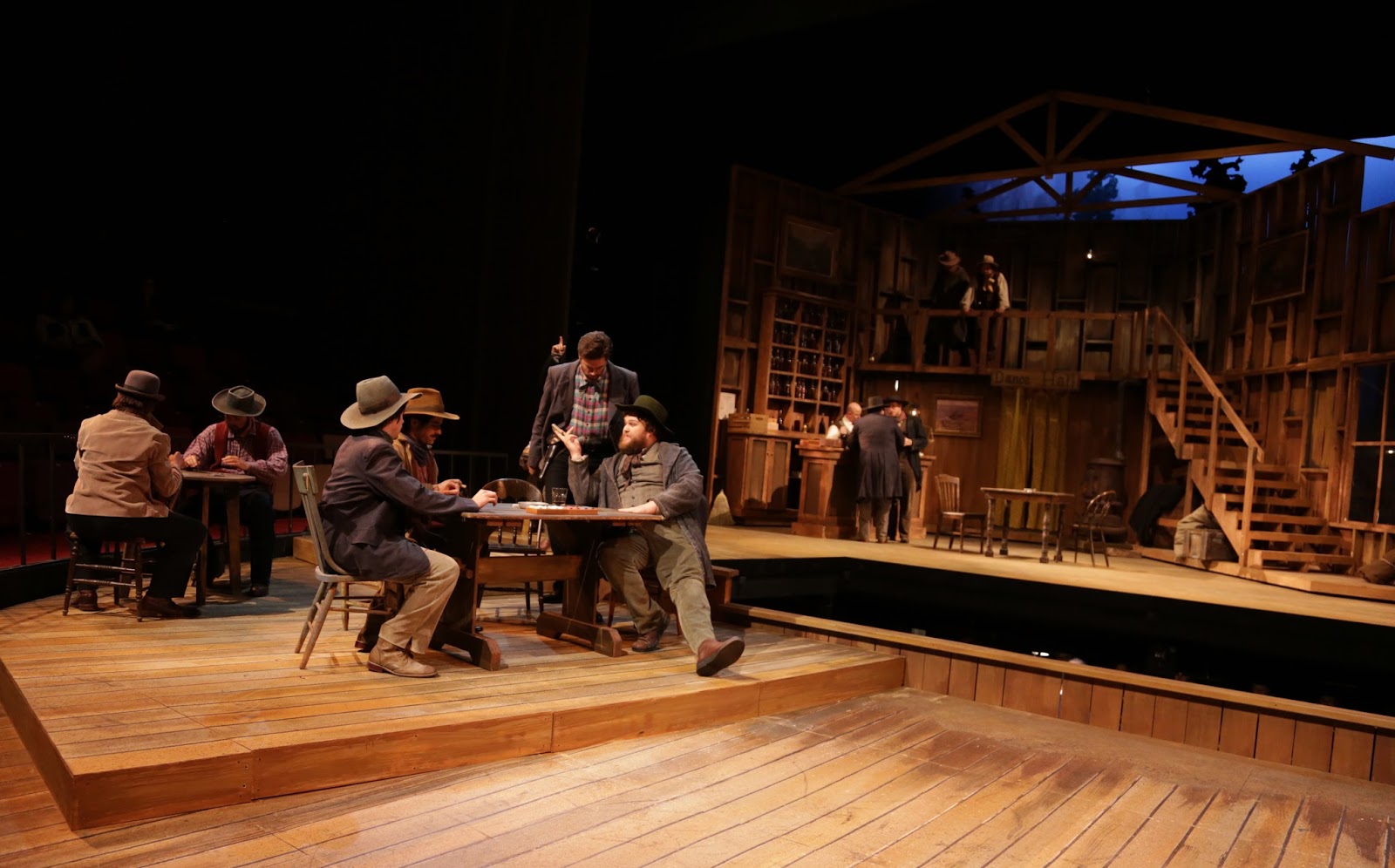
| Act I: The Polka Saloon | ©2015 All Photos Courtesy of Des Moines Metro Opera (DMMO) |
Why would information about an opera performed in Des Moines appeal to readers of a Denver-centric music publication? First, you have two major participants in the Iowa production—the director and the title character—taking on similar positions in an upcoming Opera Colorado offering, namely Aida in November 2015. Second, strong rumors abound that this operatic rarity may FINALLY grace a Front Range stage, possibly as early as fall 2016. Third, and most importantly, whenever a small-market opera company manages to produce an unqualified success on a (relatively) limited budget—that is newsworthy no matter how distant the venue!
As part of its 43rd summer festival season, the Des Moines
Metro Opera (DMMO) celebrated the Fourth of July with a matinee performance of
Giacomo Puccini’s La fanciulla del West,
a reasonably faithful operatic interpretation of one of the turn-of-the-20th-century’s
top dramas, “The Girl of the Golden West,” written by American playwright David
Belasco. While nowhere near as famous as
Puccini’s Big Three—La bohème, Madama Butterfly (also based on a
Belasco play) and Tosca—and far
less-often performed, “Fanciulla” offers three things that comprise a really
good opera: a plausible story, conflicted characters, and great music.
Set in California’s Sierra Nevada Range, “Fanciulla” is a
three-act gem whose trio of main characters—saloon owner Minnie, sheriff Jack
Rance and outsider Dick Johnson (the nom de
guerre of the bandit Ramerrez)—are supported by a company of miners and
other hangers-on who gravitate to the Polka Saloon as their sole means of
entertainment in an otherwise brutal existence, especially in winter when the
opera’s action takes place. But while the
surface story deals with Johnson’s initial plan to rob the miners of their
gold—Minnie’s establishment acts as a depository until the ore is sent onward
via courier for processing—and Rance’s anxiety over capturing the outlaw, the
subtext combines the timeless conflict of a basic love triangle with a closing
message of redemption.
A more iconic Independence Day venue than a small town in
Middle America would be difficult to find for an opera about California’s Gold
Rush days. Fifteen miles south of Des
Moines, the city of Indianola is home to Blank Performing Arts Center on the
campus of Simpson College [est. 1860].
In the auditorium, with room for just under 500 patrons, one is never
farther from the stage than a dozen rows, and a mere seven rows on the sides.
This allows singers to comfortably perform without having to project their voices
hundreds of feet into the “rafters.” The
semi-circular seating design offers a sense of intimacy and presents an agreeable
visual experience without reproducing the in-the-round acoustical issues that
tend to give singers nightmares in venues such as Denver’s Boettcher Concert Hall.
Pretty much every opera requires some suspension of
disbelief, especially when it comes to matching the maturity of a singer’s
vocal requirements to a character’s assumed or implied youth. No one expects a teenager to adequately
perform the vocally challenging roles of Juliet, Lucia or Butterfly, to name just
three famous sub-20-year-old characters.
But if the “Met in HD” series has taught us anything, with its
high-definition cinecasts and extreme close-ups, it’s that disbelief can only
take one so far when confronted with a 50-year-old Minnie, a 47-year-old Dick
and a 51-year-old Jack, no matter how celebrated the singers. This is one of those elements that made the
DMMO production so delightful, anchored as it was by a trio of youthful,
exuberant opera singers who—for once—looked the part as well as lived it.
Even though the title character doesn’t come onstage until
action is well underway, common to other high-profile Puccini heroines, the
appearance of soprano Alexandra Lobianco
electrified the audience as much as it did the group of brawling miners. Firing her rifle to get her patrons’
attention and exhibiting a tavern-owning swagger that belied her character’s
presumed youth—early 20s at the most—Lobianco started off with a strong vocal
performance that never lagged. Minnie
has a couple of arias scattered throughout the opera including the sweetly
instructive “Dove eravamo?” the Bible lesson she gives to the miners in Act I, as
well as the highly emotional final scene where [spoiler alert] she convinces the lynch mob to let her carry off a
wounded Dick Johnson to some unknown romantic future together. However, Lobianco’s personal highlight was
the extensive Act II poker game with the sheriff to gain Dick Johnson’s
freedom. Puccini put a lot of trust in
his prima donna to carry the scene
vocally as well as dramatically—especially since she is onstage the entire act
and the card game comes at the very end of it—and Lobianco was clearly up to
the task. Her other shining moment is
also worthy of mention. Riding a
stallion onstage in the middle of Act III to come to her paramour’s rescue,
Lobianco looked perfectly at home on that horse, smooth dismount and all. That’s pretty good for a woman who hails from
the wilds of St. Petersburg, Florida.
 |
| Alexandra Lobianco as Minnie |
Sheriff Jack Rance is a man caught between his vow as an
officer of the law and his unrequited love (or perhaps lust) for the mining
camp’s only available female. He is
nonetheless an honorable man, a significant distance character-wise from one’s standard
operatic villain whose main identifier is a low-pitched voice, as embodied by Scarpia [Tosca] or Iago [Otello]. The librettists
made Rance their most three-dimensional personality, and bass-baritone Kristopher Irmiter was equal to the
task. Faced with the Act I piece,
“Minnie, dalla mia casa,” as much sung dialogue as it is aria, Rance confesses
his love for the saloon-keeper and offers to marry her. Irmiter managed the song’s
one-and-a-half-octave range with ease, taking advantage of the audience’s
proximity to faithfully follow Puccini’s markings of pianissimo where
appropriate and thereby exhibit the traits of sincerity and directness the
composer had intended. It was a
sublimely enjoyable two minutes of music.
And even though anyone familiar
with the storyline knows that Rance discovers Johnson’s hiding place because
blood leaking from the outlaw’s bullet wounds drips down onto the sheriff just
as he’s about to leave Minnie’s cabin, Irmiter played the part with such
convincing incredulity at seeing blood appear seemingly out of nowhere, one
almost expected a surprise plot twist.
As brief as the scene might have been, it was brilliantly acted.
Given the fact that Puccini created Dick Johnson expressly
for Enrico Caruso, one might presume a tenor singing this part might feel
intimidated enough to have it affect their performance, the way a handful of
Cubs’ outfielders might have felt about wearing Billy Williams’ No. 26 until
the team got around to retiring it in 1987; Larry Biittner’s uninspiring career
springs to mind. But nothing of the sort
occurred when Jonathan Burton strolled
into the Polka Saloon as if he owned it, saddle slung over one arm as he
demanded a “whiskey and water” in a strong, clear, perfectly intonated tenor
voice. Despite the ridicule to which his
character is subjected by the chorus of the unwashed, he confidently introduces
himself as Dick Johnson from Sacramento and reminds Minnie they’d met
previously in Monterrey. Of course, we
all know he’s really Ramerrez the bandit, planning with his Mexican mates to
abscond with the miners’ hardscrabble earnings that very night. In one of the opera’s more tender moments,
Burton and Lobianco enjoyed a waltz to a tune hummed by the saloon’s
patrons. The duet they began as their
dancing continues—interspersed with vocal lines and pauses—until the end of the act, clearly offered the
audience a chance to enjoy these two voices meld with near-perfection as Minnie
confesses her love for Dick and convinces him to visit her cabin in Act II. It is there where the pair alternate between
romance and rancor, especially when Johnson confesses his original plan to
steal the gold. Having departed the
cabin, he returns after being seriously wounded by the men hot on his trail,
whereupon Minnie hides him in her attic to set up the fateful card-playing
scene. But Burton’s big moment came near
the very end of the opera, where Dick is led to an impromptu gallows and pleads
with the men to let Minnie think he simply slipped away, never to return. The aria “Ch’ella mi creda” is the
showstopper that helped cement Caruso’s U.S. career—even though he never
recorded it due to a disagreement with the publisher—and Burton’s emotional interpretation
showed he had just as much vocal and theatrical command of his role at the end
of Act III as he did when he first strode into Minnie’s establishment,
seemingly a lifetime earlier.
 |
| Act III: Finale |
La
fanciulla del West is notable not only for its incongruously placed
Americanisms—fans accustomed to Italian opera will find the opening number
“Hello! Hello! Alla Polka” a bit disconcerting to the ear—but also its reliance
on 15 “named” characters in supporting roles, some with fairly extensive solo
passages,. This is contrary to most works
in the standard repertoire, where even the grandest of operas augment the main
characters with a mostly faceless chorus.
Puccini’s methodology serves to humanize the group while still allowing
them to act in a single voice where appropriate.
Bass-baritone Christopher
Job, who hails from Orange County, California, was “Ashby,” the Wells Fargo
agent who convinces the locals to hunt down the bandit Ramerrez/Johnson. Tenor John
Robert Lindsey of Fort Collins, one of DMMO’s apprentice artists this
season, was in the tertiary role of “Joe.”
Both singers are well known to Denver-area opera aficionados, thanks to
their appearances in local productions as well as participation in years past
in Denver Lyric Opera Guild and Metropolitan Opera competitions. Job combined a sonorously resonant depth of
voice with some serious acting chops, helping bring to life a stage character
far more important to the action in Belasco’s play than the way Puccini (via librettists
Civinni and Zangarini) employs him in the opera. Meanwhile, Lindsey’s slender frame and boyish
good looks fit his character perfectly, with a strong tenor voice that proved
well-suited to his role.
One other singer in a secondary role deserves special
mention. Appearing in only a couple of
scenes, bass Brent Michael Smith was
“Billy Jackrabbit,” the Indian of the group (with apologies to ex-Mothers of
Invention’s Jimmy Carl Black). Despite
the fact this is pretty much a throwaway role, Smith made the most of his brief
first- and second-act appearances. One
would hope to see him in more prominent roles before very long.
The set, created by R.
Keith Brumley (with lighting by Barry
Steele), provided an imaginative use of space. As expected in such a compact venue, the
stage itself is relatively shallow as measured from the proscenium rearward. Brumley’s design included flooring laid over
roughly 50 percent of the orchestra pit—this left a center square open for the
music to “leak out”—that helped extend the stage out into the semi-circular
apron to within just a few feet of the front row of seats. A cozy theater was thereby rendered even more
intimate, as if a troupe of singers had stopped by to perform in one’s front
parlor.
Stage director David
Gately used this extra space with great creativity, having the apron serve
as the Act I main barroom floor and the Act III campfire setting. Since no self-respecting Western is without
its bar fight— Puccini orchestrated a doozy for early in the opera, which comes
to an abrupt end via some attention-getting gunfire—Gately and his assistant Michael Yeshion crafted a
well-choreographed brawl that utilized every inch of space while ensuring that
none of the singers went tumbling into the pit.
And considering the twenty-plus miners involved in everything from
card-playing to drinking to letter-writing to all-out carousing, Gately’s
finely tuned sensibilities never allowed any of this activity to distract from
the business at hand—the singing.
That’s not to say things went flawlessly. Conductor David Neely found it challenging to prevent the music coming out of
the pit from overpowering the singers, especially since Puccini’s scoring calls
for a larger-than-average orchestra.
Irmiter’s Jack Rance was victimized a couple of times by an
over-exuberant brass section, despite the fact he owns anything but an underpowered
vocal instrument. It could be that the
psychology of performing in such intimate surroundings renders a singer less
likely to feel the need to project much beyond 30 feet or so. Meanwhile, an orchestra sequestered below
stage level finds itself less likely to possess adequate spatial awareness of
the size of the venue. This was but a
minor annoyance, however, and Maestro Neely was otherwise in fine command of
his very talented musicians.
Des Moines Metro Opera will present La fanciulla del West twice more this season, as well as additional performances of its other two festival offerings: Mozart’s Abduction from the Seraglio and Janáček’s Jenůfa. The festival continues through mid-July, and further details are available via the opera company’s website. The company has already announced next year’s summer festival program, which will include Falstaff (Verdi), Manon (Massenet) and Orfeo (Gluck) and run from June 24 through July 17, 2016.


